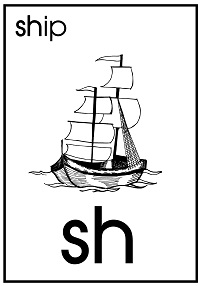
Below is a sample of the Grapheme & Picture section of the Cracking the ABC Code Multisensory Reading Level 2 Program
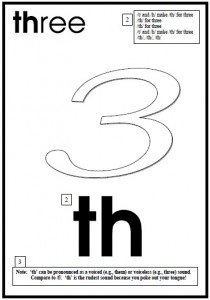
This section is the key to the success of the programme.
- One grapheme (a letter or combination of letters) is introduced each week.
- Each grapheme is linked to a key word and an accompanying picture to assist in retention and recall.
- At this level graphemes are introduced one at a time as many students, especially those experiencing difficulty with learning to read, find that when the multiple ways that a phoneme (sound) can be represented are introduced at the same time it causes cognitive overload and then nothing is learned particularly effectively.
Note: Teach and encourage the student to use the following strategy when trying to work out the spelling of unfamiliar words.
- Say the sounds in the word (e.g. sheet = sh-ee-t).
- Ask: What makes the /sh/ sound? Answer: /s/ and /h/ as in ship. Write it down.
- Ask: What makes the /ee/ sound? Answer: /e/ and /e/ as in tree. Write it down.
- What is the last sound? Answer: /t/. Write it down.
- If student answers, “/e/ and /a/ make /ee/ as in leaf,” say, “Yes, that’s correct. What else makes the /ee/sound?
- At the beginning of each session:
- Ask student to trace over each grapheme that has already been learned while saying the sounds of the letters, the phoneme and the accompanying key word (e.g., /s/ and /h/ make /sh/ for ship, /c/ and /h/ make /ch/ for chick, /t/ and /h/ make /th/ for three).
- It is very important that students say the letter sounds /t/ and /h/ and NOT the letter names ‘t’ and ‘h’ as this reinforces prior learning and links new learning to previous knowledge which enhances retention of the information (see Sjöström, Rancz, Roth & Hausser, 2008 for a discussion of the research in this area).
2. Each day:
- The student practises the grapheme currently being learned using the following clapping pattern and an appropriate action (e.g., /ch/ for chick – make a beak using one hand, /th/ for three – hold up 3 fingers, /ie/ for kite – make the shape of a kite by joining the thumb and pointer finger of each hand, etc).
- The inclusion of the clapping pattern is a key component of the learning process as the research indicates that movement enhances learning (see for example, Cook, Yip, & Goldin-Meadow, 2010).
/t/ and /h/ make /th/ for three
[slap] [clap] [slap] [clap] [slap] [clap] [put up 3 fingers]
/th/ for three
[slap] [clap] [put up 3 fingers]
/th/ for three
[slap] [clap] [put up 3 fingers]
/t/ and /h/ make /th/ for three
[slap] [clap] [slap] [clap] [slap] [clap] [put up 3 fingers]
/th/ /th/ /th/
[slap] [clap] [slap]
3. When introducing the sound:
- Discuss other information provided on the page.
- This provides students with orthographic knowledge which assists in them becoming proficient readers and spellers (see Holmes & Quinn, 2009).
References
Cook, S., Yip, T., & Goldin-Meadow, S., (2010). Gesturing makes memories that last, Journal of Memory and Language, 63 (4), 465-475.
Sjöström, P., Rancz, E., Roth, & Hausser, M. (2008). Dendritic excitability and synaptic plasticity. Physiological Reviews, 88, 769-840.

Click on the images to purchase.