
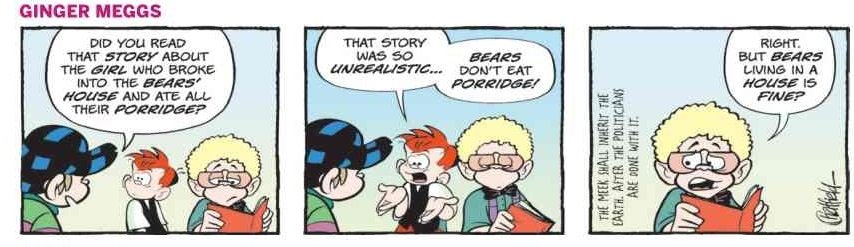
This cartoon prompted me to think that fairy tales would be a great medium to introduce the concept, and help students develop the skill, of determining whether or not information read could be a fact or is definitely fiction.
- Depending on students’ reading ability they can either read a fairy tale or it can be read to them.
- Take some sentences from the story and model for students (using the think aloud strategy) the process of determining whether or not the information could in fact be true/believable or whether it is fiction/unbelievable.
Example 1: Once upon a time there was a family of three bears who live in a forest.
Think aloud: I know many bears, like brown bears and black bears, live in forests so that part is believable. But, bears don’t usually live together as a family. In fact, male bears always live by themselves and baby bears (which are called cubs) only live with their mothers for the first 1½ to 3 years, so that part is unbelievable and must be fiction.
Example 2: They lived together in a cozy little cottage built by father bear.
Think aloud: Bears don’t live in houses and they certainly can’t build houses, so this is unbelievable and must be fiction.
- Read some sentences from the story. If the student thinks the information in the story is believable and could be a fact, they put their hands on their head. If they think the information in the story is unbelievable and therefore is fiction, they fold their arms. If students are unsure or if part of the sentence is believable and a part is unbelievable, they can sit on their hands.
- Choose students to defend their decision.
- Give pairs of students pre-prepared sentences written on strips of paper. Together they sort the strips into a fact pile or a fiction pile. Walk around the room asking students to defend their decisions for particular sentences.
- Provide each student with a list of sentences taken from the story presented in a table. Students decide if the sentences are fact or fiction. Leave sufficient room after each sentence for students to explain why a particular sentence is unbelievable.
| Sentence | Fact | Fiction | Both |
| Goldilocks went up to the cottage and peeped in at the window. Why? | |||
| On the table she saw three bowls of porridge. Why? | |||
| “Who’s been eating my porridge?” asked Daddy Bear in his great big voice. Why? | |||
- As a group discuss a recent activity in which everyone has participated. It could be as simple as taking the students outside and playing a game.
- Brainstorm the key events:
*Class stood up and walked outside.
*The teacher divided the class into two teams.
*One team made a large circle and the other team stood in the middle.
*The team in the circle were given two balls which they threw at the students in the middle.
*If a student was hit by a ball, they joined the circle.
*When no-one was left in the circle, everyone walked back to the classroom.
- Now add in some unbelievable components.
*Class stood up and flew outside.
*The teacher divided the class into two teams.
*One team made a large circle and the other team stood in the middle.
*The team in the circle were given two balls which they threw at the students in the middle.
*If a student was hit by a ball, they disappeared.
*When no-one was left in the circle, everyone flew back to the classroom.
- Using the group example, have students create their own story map of a real event and then add in some unbelievable components. It is important that students only change a few elements in the story.
- Students write their own fairy tale.
- Students can swap their writing with each other to see if other students can determine the unbelievable/fiction components of their story.