

Proficient readers can look at a sequence of letters and automatically recognise them as being familiar and associate them with the correct pronunciation of a word or a morpheme (prefix, suffix or stem). Words that can be instantly recognised are ‘sight words’ (not to be confused with high frequency words).
On the surface, it would seem that proficient readers are processing this sequence of letters as a single unit. Yet researchers, such as Dehaene (2010), have found that even in the brains of proficient readers every single letter is processed. The brain does not look at the whole word shape. It is just that proficient readers can process these letter sequences quicker because they are very familiar with a large number of words.
Therefore, it is essential to teach beginning readers letter-to-sound correspondences and then to blend these sounds together to form a word. For example, on seeing the letter sequence ‘sat’, you would say the sounds /s/…/a/…/t/ and then blend these three sounds together to say the word ‘sat’. This is commonly referred to as ‘sounding out’.
The more letter-to-sound correspondences you know the more words you are able to accurately decode. For example, knowing the sounds represented by the letters a, p, n, c, t enables you to decode – pat, pan, pact, act, ant, apt, an, at, nap, nan, cat, can, cap, tan, tap and tact.
It is important to keep in mind, that your ability to decode these words is also influenced by your knowledge of the meaning of these words and working memory. You need to be able to:
- Quickly and accurately recognise the letters and the sounds they represent.
- Then hold this information in your working memory for each individual sound long enough to be able to blend the sounds together.
- And then, recognise the blended sounds as a particular word.
- This requires good phonological awareness and if this is an underlying area of weakness, it needs to be an integral part of the reading program.
If you have difficulty instantly recognising the individual letter sounds, then this will place a very large load on your working memory and make the blending process difficult.
However, being able to sound out is only a part of the story. Once you have decoded (sounded out) a word, you need to store that string of letters in your long-term memory so when you encounter this same sequence of letters again, you will be able to automatically recognise the word. This process is orthographic mapping.
This means that it is not sufficient just to teach students how to ‘sound out’, they also must be given opportunities to store the sounded-out word in long-term memory.
Sounding out strategies for students experiencing difficulties.
- Practise blending sounds without any visual cues. See the blending section in this post.
- Ensure the student has excellent and automatic recall of the letters or letter combinations (graphemes) in isolation. You can easily test this by showing the grapheme on a card for a second and seeing if the student can immediately tell you the sound. There are lots of games, activities and resources available to assist in learning this information.
- Encourage the student to elongate the sound of each letter (e.g., sssss…aaaaa…t). However, be aware that this cannot be done with some sounds (e.g., /t/, /p/, etc.).
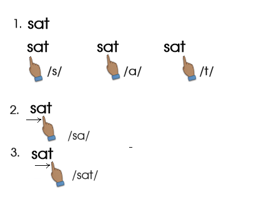
- If the student is finding it difficult to remember and blend 3 or more letters, you can try the following.
- Ask the student to point to each letter and say the sound (e.g., /s/…/a/…/t/).
- Then go back to the beginning and ask the student just to say and blend just the first two letters (e.g., /s/…/a/…./sa/) while dragging their finger underneath those two letters.
- Ask them to say the sound of the last letter (/t/).
- Then, go back to the beginning and have them blend all three letters.
- You might find it useful to model the process and for some students it can be useful to help move their finger smoothly between the letters.
- It can be useful to use letter tiles (cards with one grapheme on each card).
- It might also be useful to cover up the letter(s) you don’t want the student to blend.
- Many students find it useful to use a ‘sound phone’ as it enables them to hear the sounds more clearly.

Storing words in long-term memory
- Once a student has sounded out a word, they need practise at automatically recognising and reading the word without going through the sounding out process.
- After a word has been sounded out, tell students that they now have to remember the word.
- Cover up the word with your finger. At different time intervals, lift your finger and the student reads the word. It is important that you use different time intervals as this ensures the student is focused on the word and not just randomly repeating the word without actually focusing on the letter string. I usually do this three times.
- Have students sound out and blend the next word. Repeat the above activity three times. Then have the student read the two words they have learned.
- Repeat the process again with a third word and then have the student read all three words.I would recommend limiting the activity to three words at a time to reduce the load on working memory.
- You can then repeat the process with the next three words students are learning.
- The next step would be to see if the student can remember all six words.
- If the student has difficulty remembering any particular word, go back to step one with just that word.
- Some students get ‘stuck’ in the sounding out phase and find it difficult to move to automatically recognising a letter string as familiar and to relate it to the pronunciation of a word. Often this is because once they have sounded out the word, they look away to blend and consequently they never develop an orthographic map for that word.
- Once you know students can easily sound out and blend, ask them to sound out and blend silently.
- When they have blended the word, they say the whole word out loud.
- It is critical that during this process the student is looking at the word at all times.
- It can also be beneficial for students to do rapid decoding activities which contain the graphemes they are learning or know and have a repeated letter string (e.g., fit, bit, lit, hit or chin, chick, chip, chill or shed, shod, shut, sham).
- An last important step in the process is to have the student read sentences which contain the words being remembered in isolation. The Cracking the ABC Code Multisensory Reading programs use this integration process at all levels.
References
Dehaene, S. (2010). Reading in the brain: The new science of how we read. New York: Penguin Books.
Schurz, M., Sturm, D., Richlan, F., Kronbichler, M., Ladurner, G., & Wimmer, H. (2010). A dual-route perspective on brain activation in response to visual words: Evidence for a length by lexicality interaction in the visual word form area (VWFA) Neuroimage, 49(3), 2649–2661.